Traveling and AI/KI Series
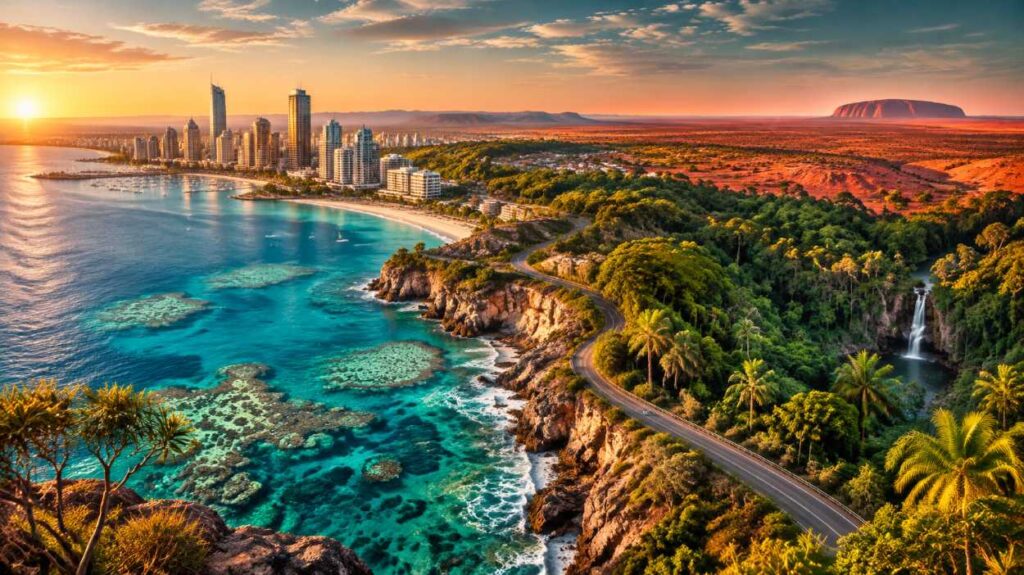
Australia is often introduced through a small collection of famous images: modern harbour cities, brilliant beaches, coral reefs, distinctive wildlife and the immense red landscapes of the outback. Yet the country is far more diverse than any single postcard can show.
Traveling Australia is the second international destination section of the Traveling Community on cms-blogger.eu. It will become a growing editorial and community space for carefully researched articles about Australian cities, regions, natural environments, cultures, technologies and future perspectives.
This introductory article establishes the foundation for that journey and for our growing digital travel book.
Australia Between Ocean, Continent and Community
Australia is both a country and a continent. Its geography includes tropical rainforests, long coastal regions, deserts, mountain landscapes, islands, wetlands and major urban areas.
Sydney, Melbourne, Brisbane, Perth, Adelaide, Canberra, Darwin and Hobart present different combinations of architecture, community life, climate, cultural activity and access to nature.
Traveling Australia will not treat the country as a single destination. Future articles will explore individual cities, states, territories and cultural regions on their own terms.
Cities and Urban Perspectives
Australia’s cities offer very different perspectives on contemporary life, architecture, mobility, culture and technology.
Sydney and Its Harbour Region
Sydney is internationally associated with its harbour, coastline, beaches and distinctive architecture. The city can become the starting point for future articles about waterfront development, public transport, cultural institutions, coastal walks and the relationship between a large metropolitan region and its natural environment.
Melbourne and Victoria
Melbourne is widely known for food, live music, cultural institutions, sporting events and urban laneways. The surrounding state of Victoria adds coastal routes, rural regions, national parks and regional communities to the editorial journey.
Brisbane and Queensland
Brisbane combines a subtropical setting with a growing metropolitan region. Queensland also provides access to some of Australia’s best-known marine, coastal and tropical environments.
Perth and Western Australia
Perth connects a modern western city with the Indian Ocean and the immense distances of Western Australia. Future articles may examine urban life, coastal regions, remote communities, mining technologies, environmental research and long-distance travel.
Canberra and the National Capital
Canberra offers a different perspective as the national capital. Museums, public institutions, national collections, planning, architecture and nearby natural areas can all become subjects for future researched articles.
Adelaide, Hobart and Darwin
Adelaide, Hobart and Darwin create additional starting points for coverage of regional identity, food cultures, architecture, museums, public spaces, tropical environments, Tasmania and access to remote landscapes.
Future Urban Research Topics
- Urban architecture and public spaces
- Museums and cultural institutions
- Digital infrastructure and innovation districts
- Public transport and regional mobility
- Accessible travel
- Local food cultures
- Waterfront development
- Climate-conscious city planning
- Technology, education and scientific research
Nature Beyond a Postcard
Australia has some of the world’s most recognizable natural environments. Tropical northern landscapes, Tasmania, Kangaroo Island, desert regions, extensive coastlines and marine ecosystems create very different travel experiences.
These environments are not merely visual attractions. They are living ecosystems that require responsible travel, environmental awareness and respect for local guidance.
Articles in this section will distinguish between visual inspiration and verified travel information. Environmental conditions, access rules, conservation measures and safety advice can change. Practical guidance should therefore always be checked against current official sources before a journey.
The Great Barrier Reef and Marine Environments
The Great Barrier Reef is the world’s largest coral reef system and one of Australia’s most internationally recognized natural environments.
The reef supports an extraordinary variety of marine life and forms part of a wider region that includes islands, coastal communities and scientific research locations. Near the reef, the Daintree Rainforest adds another ancient and ecologically significant environment.
Future articles should examine the Great Barrier Reef from several perspectives:
- Marine biodiversity
- Responsible reef tourism
- Coral and climate research
- Environmental monitoring
- Local operators and communities
- Accessible marine experiences
- Visitor behaviour and conservation
The goal is not only to present beautiful images. The goal is to explain how travelers can experience marine environments responsibly and why long-term protection matters.
Rainforests, Islands and Coastal Landscapes
Australia’s tropical rainforests, islands and coastal landscapes provide subjects for an extensive collection of future travel chapters.
Potential destinations include Queensland’s tropical north, Tasmania, Kangaroo Island, the Whitsundays, Rottnest Island, Bruny Island and numerous coastal routes.
Each region requires its own research into environmental conditions, local communities, transport, accessibility, seasonal factors and responsible visitor behaviour.
The Outback and the Red Horizon
The Australian outback has a particularly strong visual connection with the Computing Planet Mars vision of the Affronter Ecosystem.
Rust-red terrain, immense horizons, geological formations and dark night skies can evoke ideas of exploration, science and life beyond familiar environments.
This connection will be used as an editorial and artistic theme. It must never replace the real cultural, historical and environmental meaning of Australian landscapes.
Respecting Uluṟu and Kata Tjuṯa
Places such as Uluṟu and Kata Tjuṯa require especially careful treatment. These locations are not simply dramatic geological attractions.
Cultural meaning, local rules and the perspectives of Traditional Owners must be respected in travel writing, photography and visual storytelling.
The Traveling Community will approach these subjects with cultural care, source awareness and a clear distinction between documented facts, community experiences and creative future visions.
Culture, Knowledge and Respect
Australia’s cultural story cannot be responsibly presented without acknowledging Aboriginal and Torres Strait Islander peoples and the continuing importance of cultures, knowledge systems, languages and relationships with Country.
Future articles should use respectful terminology, prioritize authoritative and community-supported sources and avoid reducing living cultures to decorative travel imagery.
Topics for Culturally Responsible Research
- Cultural centres and museums
- Guided experiences led by Aboriginal and Torres Strait Islander people
- Regional languages and place names
- Art and storytelling
- Relationships with land and water
- Cultural protocols for visitors
- Ethical purchasing of art
- Responsible photography
- Historical and contemporary perspectives
The purpose is not to speak on behalf of communities. The purpose is to guide readers toward appropriate sources, respectful engagement and a deeper understanding of place.
Wildlife and Responsible Encounters
Australia is internationally associated with distinctive wildlife, including kangaroos, koalas, echidnas, wombats, marine animals and numerous bird species.
Wildlife tourism requires distance, patience and responsible behaviour. Animals should not be treated as props for social media.
Visitors should follow park rules, avoid feeding wild animals and choose reputable operators that place animal welfare and conservation before entertainment.
Responsible Wildlife Principles
- Observe wildlife from a safe and respectful distance
- Do not feed wild animals
- Follow local park and conservation rules
- Avoid disturbing nesting or resting animals
- Choose reputable wildlife and marine operators
- Keep natural environments free from waste
- Use photography without interfering with animal behaviour
Future articles will examine wildlife encounters from the perspectives of conservation, accessibility, safety and environmental responsibility.
Science, Technology and Innovation
Travel is also a way to understand how a country approaches science, technology and the future.
Australia contributes to research and development in astronomy, marine science, climate observation, medicine, agriculture, engineering, digital technologies and environmental monitoring.
Universities, observatories, museums, research institutions and innovation districts can become important destinations for readers who want to explore more than conventional sightseeing.
Future Science and Technology Topics
- Astronomy and dark-sky locations
- Marine and reef research
- Climate science
- Environmental monitoring
- Robotics and artificial intelligence
- Digital public services
- Renewable energy
- Remote communications
- Medical research
- Future mobility
- Australian participation in international space research
These topics connect Traveling Australia with the broader AI, science and Computing Planet Mars themes of cms-blogger.eu.
Australia and the Computing Planet Mars Vision
The Computing Planet Mars vision represents exploration, international cooperation, technology, knowledge and a willingness to think beyond familiar limits.
Australia offers a meaningful Earth-based connection to that vision. The red interior, remote research environments, large observational landscapes and advanced scientific communities create opportunities to discuss how people prepare for difficult environments, protect limited resources and build resilient systems.
This does not mean presenting Australian landscapes as empty or alien. These places already possess ecological, cultural and historical meaning.
The connection to Mars must remain respectful, symbolic and future-oriented.
Traveling and Artificial Intelligence
The new Traveling and AI/KI series will examine how artificial intelligence can support responsible travel research without replacing human judgment, local expertise or authoritative information.
Possible Uses of AI in Travel Research
- Organizing research questions
- Comparing official destination information
- Preparing accessible summaries
- Supporting multilingual travel content
- Structuring itineraries for later human review
- Identifying topics that require current verification
- Generating visual concepts without copying protected designs
- Connecting blog articles with community discussions
What AI Should Not Replace
- Current official safety advice
- Entry and visa requirements
- Local cultural guidance
- Environmental restrictions
- Medical advice
- Expert assessments
- Human editorial responsibility
Every AI-supported article on cms-blogger.eu should distinguish verified information, editorial interpretation, community knowledge and creative future perspectives.
Sustainable and Accessible Travel
A modern travel guide should not focus only on destinations. It should also ask how travel affects places and people.
Responsible Travel Considerations
- Choose appropriate seasons and routes
- Respect protected environments
- Reduce avoidable waste
- Use water and other resources responsibly
- Support local and regional businesses
- Select reputable tour operators
- Follow cultural guidance
- Plan accessible journeys
- Understand distances and climate conditions
- Check current fire, weather and transport information
Detailed practical articles on cms-blogger.eu will link to current official information instead of presenting permanent travel guarantees.
A Growing Australia Travel Guide
Traveling Australia is not intended to remain a single introductory post. It will become part of a growing digital travel book on cms-blogger.eu.
Planned Australian Chapters
- Sydney and its harbour region
- Melbourne and Victoria
- Brisbane and Queensland
- Perth and Western Australia
- Adelaide and South Australia
- Canberra and the Australian Capital Territory
- Darwin and the Northern Territory
- Hobart and Tasmania
- The Great Barrier Reef
- The Daintree Rainforest
- The Australian outback
- National parks
- Coastal road journeys
- Islands and marine environments
- Architecture and city planning
- Culture and museums
- Science and technology
- Astronomy and space research
- Sustainable travel
- Accessible travel
- Community experiences
Each article will separate verified information, editorial interpretation, personal reports, community contributions and future-oriented ideas.
Join the Australia Traveling Community
The accompanying Australia forum provides a place for readers to continue the journey.
Community members can recommend destinations, ask questions, share experiences, suggest research topics and discuss how Australian places should be represented in future articles.
The goal is to build a useful international knowledge space rather than a collection of superficial destination lists.
Which Australian destination, cultural experience, natural landscape or technology location should the Traveling Community explore next?
Welcome to Traveling Australia.
Official Information and Further Research
Tourism Australia: Official International Travel Information
Tourism Australia: Official German Travel Information
Tourism Australia: Australian Destinations and Travel Inspiration
Editorial note: This introductory article provides a general framework for the Traveling Australia section. Practical travel conditions, environmental restrictions, entry requirements, opening times, transport services and local safety information may change. Readers should verify current details through official Australian authorities, destination services and reputable local operators before traveling.